

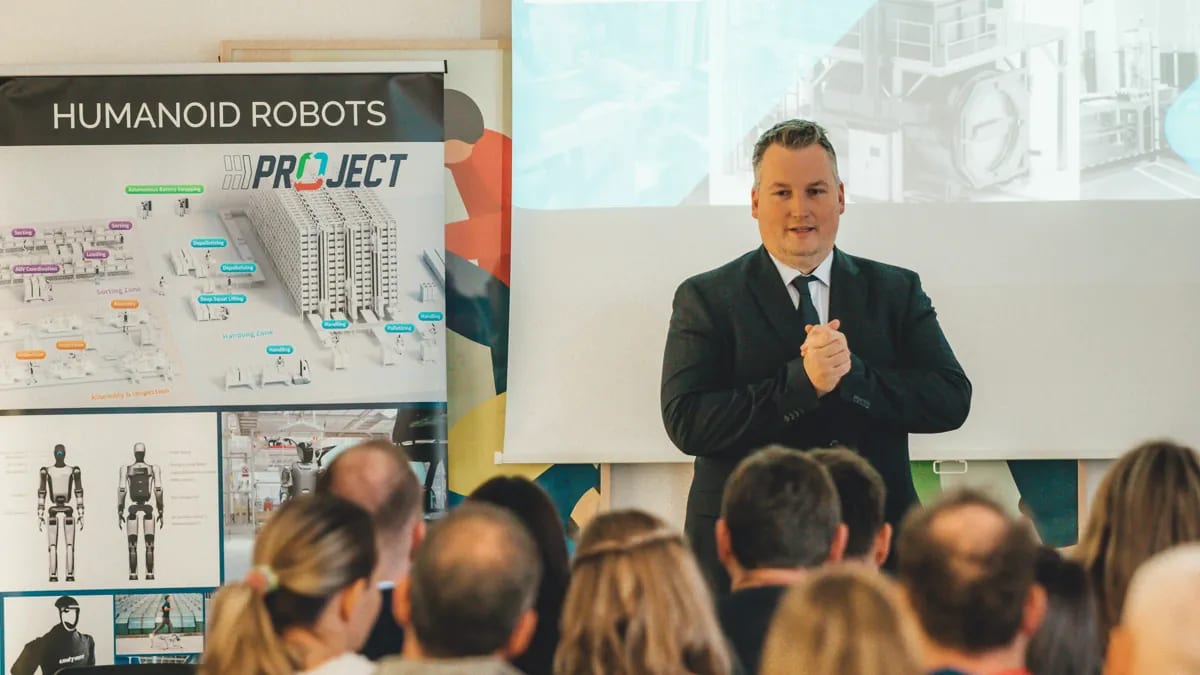
Humanoid robots are no longer the future; they are reality
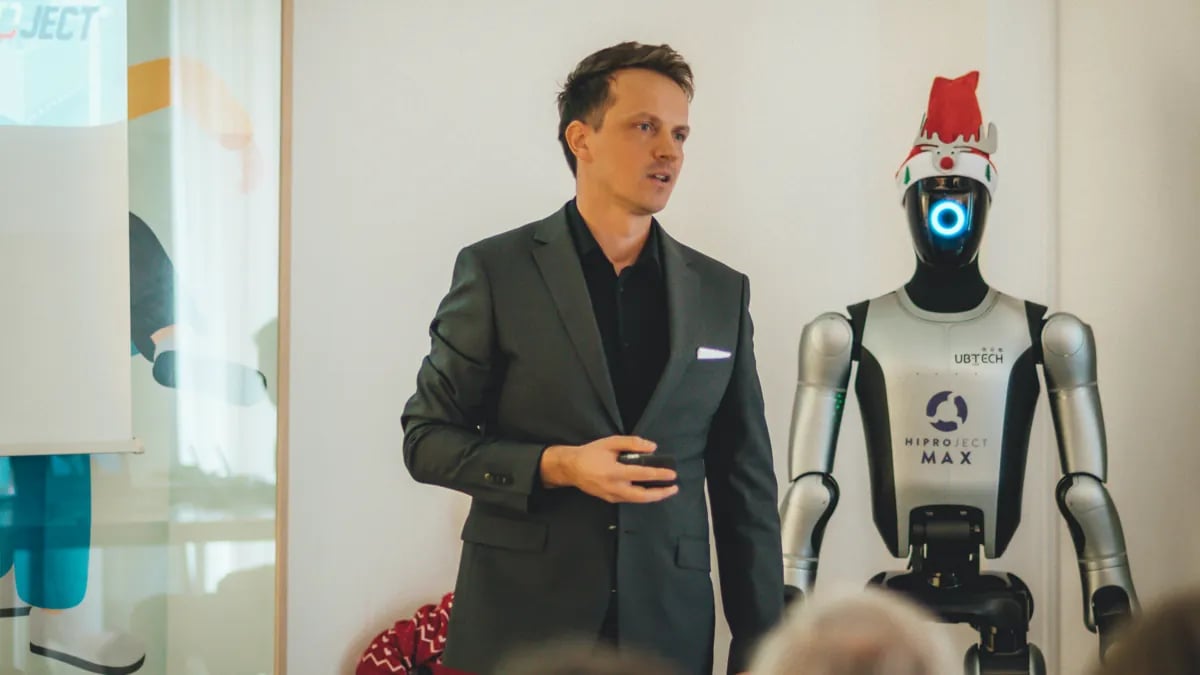
The centrepiece of the event was the presentation of the humanoid robot UBTECH Walker S2, the most advanced humanoid robot in Europe and the first able to change its own battery. The robot is designed for work in real industrial environments, where conditions are harmful, dangerous or extremely demanding for a person in the long run.
HIPROJECT director Urban Pevnik emphasised: “With existing solutions we have reached around 90 % automation in industry. The future, however, lies in humanoid robots, which can complete the person in the remaining 10-15 %. Those are the jobs in dust, in cold, under radiation and everywhere else where a person should not be.”
He adds that the goal is not to replace people but to restructure demanding jobs: “We want to create an industry in which technology relieves the person and allows them to work more safely, more creatively and sustainably in the long term.”
Education has to adapt in time
Pevnik was equally clear about the education system: “Some of the professions we teach today will no longer exist in five years. And new ones are only arriving. I would not want us to be late. That is why we have to start the conversation now, together.”
Schools cannot manage the change alone
A representative of the Ministry of Education, Borut Čampelj, highlighted the importance of schools working with their local environment. “Education alone cannot create the society of the future. It needs companies, non-governmental organisations, researchers. That cooperation is essential today.”
He drew particular attention to critical thinking and the emotional development of young people: “Research shows that children up to the age of seven do not distinguish between the human and the non-human. That is why developing critical thinking is one of the key skills of the future.”
Technology as an opportunity for local development
Nena Dokuzov highlighted the importance of technological continuity in the region. “The school centre in Slovenske Konjice was the first to introduce 3D printing. Projects like that created the technological capacity of the area, which results today in our talking about humanoid robots right here,” she explained.
She added: “We still import technology today, but this is precisely where the opportunity for Slovenian development lies: in integration, in knowledge and in people.”
Humanoid robots in the service of people
HIPROJECT head of sales Bojan Goluh explained why humanoid robots are our next logical step: “Humanoid robots have a human shape because the world is made for people: tools, door handles, workplaces. We bring the workplace to the robot, not the other way round.”
He also introduced the robot MAX: “It is 177 cm tall and weighs 70 kg. MAX stands for Autonomous Mechanical Executor. But the point is not the size; it is safe integration and working with people.”
Panel: humanoid robots, the person and the future of knowledge
The panel discussion was moderated by Nena Dokuzov.
Dr Igor Kovač of the Jožef Stefan Institute explained the fundamental logic of humanoid robotics:
“Humanoid robots have a human shape because the world is made for people: tools, door handles, workplaces. We do not adapt the environment to the robot; we adapt the robot to the existing environment.”
He also stressed Slovenia’s exceptional starting position in robotics:
“By the number of industrial robots per 10,000 employees we are third in Europe and seventh in the world. We have the knowledge, the education system and top-level research. With the most advanced humanoid robot in Europe we have an excellent opportunity to start developing humanoid robotics at home as well.”
Urban Pevnik, director of HIPROJECT, placed the discussion in the wider context of Industry 5.0 and the role of the person in the industry to come. He stressed that the goal of introducing humanoid robots is not to replace people but to reshape jobs:
“There is no such thing as a bad employee. There is, however, a bad system or bad management that cannot find the right role for a person. Our goal is for technology to take on the heaviest, most dangerous and most repetitive work, and to give the person safer, more creative and sustainable work.”
He added that industry must have the courage to think about the future of skills and professions in good time: young people need contact with the technologies of the future before they enter the labour market.
Bojan Goluh, head of sales at HIPROJECT, stressed the practical side of bringing humanoid robots into industry and drew a clear line around the company’s role:
“HIPROJECT is not a classic distributor but an integrator. With every client we first establish what they actually need. Then we advise, choose a suitable robot — we work with several manufacturers — carry out the software and system integration and the testing, and provide service and long-term maintenance. A robot on its own is not a solution.”
At present humanoid robots mainly help with simpler tasks such as sorting, loading, moving and logistics; over time they will take on ever more complex work. He particularly stressed the importance of safety and of the trust of employees, because without it technology cannot take hold in practice.
An important part of the discussion was also the vision of future infrastructure. In the renovated former Konus building, HIPROJECT is planning a robotisation centre that will bring together a research centre for the integration of humanoid robotics, an exhibition and demonstration space and an educational part for young people, professionals and industry.
The human and social dimension of technology was brought into the discussion by Tjaša Šašić Marciuš of the company Pro Bit:
“Robots cannot replace a person. They will never be social support, they will not have empathy or human contact. They can, however, take on everything else — the routine, the repetitive tasks and the strain — and so relieve professional staff, who will have more time, less stress and will do their work better.”
The panel was closed by the moderator Nena Dokuzov with a clear vision of the future:
“I hope we will be the first in Europe to develop a humanoid robot ourselves. We have the knowledge and the skills. And I hope our schools will also be the first in Europe to develop so much talent that young people can step straight into practice.”
The panel discussion showed that humanoid robots are not merely a technological challenge but a strategic opportunity for Slovenia, provided we develop them in cooperation between industry, science and education, and with a clear focus on the person.
The event showed that humanoid robots, artificial intelligence and Industry 5.0 are no longer a question of “whether” but of “how”. How we will bring them into society, how we will teach them to understand, and how we will equip young people with the knowledge they will need in a world where technology does not replace the person. Instead, it allows them to be a person again.
And in Slovenske Konjice that conversation has only just begun.